Showing The Origins of the National Security Agency, 1940-1952 by Thomas L. Burns
No recommendations yet View on Amazon (paid link)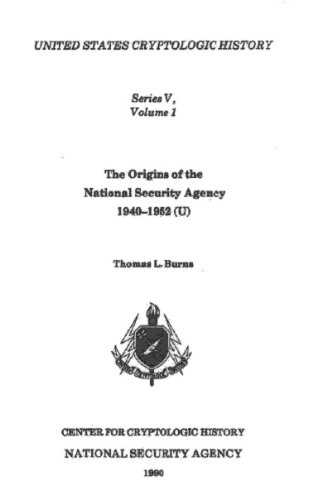
Recently declassified by the NSA!
This is a high-quality, professionally-scanned reproduction of a book which was published in 1990 and was recently declassified by the National Security Agency (NSA). Our scan may have occasional imperfections such as missing or blurred pages, time-scarred pictures or artwork, errant marks or tears, redacted portions of text, etc. that were either part of the original historical artifact, or were caused by the scanning process. We believe this book has vast cultural and political significance, and despite the imperfections, have decided to make it available in eBook format as part of our undying commitment to the preservation of historical and political publications worldwide. We hope you can appreciate the nature of these imperfections in the in the preservation and production process. Please enjoy this valuable book in its original state!
The book's description reads: "This is a masterfully researched and documented account of the evolution of a national effort following World War II, beginning with the fragile trends toward unification of the military services as they sought to cope with a greatly changed environment following ths war, and continuing through the unsatisfactory experience under the Armed Forces Security Agency. The author also makes an especially important contribution by helping us to understand the role of the civilian agencies in forcing the creation of NSA and the bureaucratic infighting by which they were able to achieve that end.
At first glance, one might think that this organisational history would be far from "best seller" material. In fact, the opposite is the truth. It is essential reading for the serious professional, both civilian and military. Mr. Burns has identified most of the major themes which have contributed to the development of the institutions which characterise our profession; the struggle between centralised and decentralised control, interservice and interagency rivalries, budget problems, tactical versus national strategic requirements, the difficulties of mechanization of processes, and the rise of a strong bureaucracy. These factors, which we recognise as still powerful and in large measure still shaping operational and institutional development, are the same ones that brought about the birth of NSA.
It remains for each reader to take what Tom Burns has presented in the way of historical feet and correlate it to his/her experience. This exercise should prove most interesting and illuminating.